
Chevalia, The Way of the Horse, Book One, Chapter Four


Chapter Four
The Architecture of Consciousness
As the journey of remembrance deepens, another question begins to arise. It is more than an intellectual curiosity because it reaches beneath nearly everything we assume about ourselves and the world we perceive: What is consciousness?
Modern science has given us extraordinary insight into the brain and the biological processes associated with conscious experience. We can observe neural activity, study memory and perception, examine the effects of injury or disease, and identify relationships between activity in the brain and changes in conscious states. Yet the nature of subjective awareness itself remains one of the great questions. We can describe much about what occurs while we are conscious without fully explaining the simple and astonishing fact that experience is happening at all.
There is seeing, and there is an awareness of seeing. There is thought, and there is an awareness that thought is occurring. There are emotions, sensations, memories, dreams, and perceptions, all appearing and disappearing within experience. This raises the question that began to fascinate me: What is it that is aware?
Ancient traditions approached this mystery from within. Through meditation, contemplation, stillness, and disciplined attention, they explored consciousness not only as something to think about, but as something that could be encountered directly.
One of the clearest examples appears in the Mandukya Upanishad, which describes four states of consciousness. There is the waking state, through which we experience the physical world through the senses. There is the dream state, in which an entire world can arise within consciousness without the ordinary external environment. There is deep sleep, where the images and narratives of waking and dreaming recede. Then the text speaks of a fourth, Turiya.
“The Fourth is unseen, beyond empirical dealings, beyond the grasp of the senses . . . peaceful, auspicious, non-dual. This is the Self.”
— Mandukya Upanishad, Verse 7
Turiya is not presented simply as another experience alongside waking, dreaming, and deep sleep. It points toward the underlying awareness in which these changing states arise.
When I later encountered teachings such as this, I did not experience them merely as philosophical ideas. Once again, I found an ancient language that seemed to recognize something I had already encountered through life. There had been moments when the ordinary boundaries of perception became quiet and awareness seemed far larger than the identity through which I normally experienced myself. Some came through horses and nature. Some came through stillness. Others, as I described earlier, came unexpectedly through profound grief when resistance finally gave way to surrender.
In those moments, consciousness did not feel contained within the story I called myself. Rather, the story of myself appeared to be occurring within something much larger.
This is one reason the ancient descriptions of consciousness became so meaningful to me. They gave me a way to contemplate an experience without requiring me to reduce the experience to an explanation. I do not need to claim that my experiences are identical to those described by ancient sages, nor do I need to force different traditions into a single philosophical system. What matters to me is the recognition that human beings across centuries have discovered through direct experience that ordinary waking thought may not represent the full extent of consciousness.
The Taoist tradition approaches this mystery differently but carries a similar reverence for what precedes conceptual thought:
“Man follows the earth.Earth follows heaven.Heaven follows the Tao.The Tao follows what is natural.”
— Tao Te Ching, Chapter 25
The natural world became indispensable to my understanding of this. Animals do not appear burdened by the same elaborate psychological identities that human beings construct. They certainly experience fear, memory, preference, relationship, learning, individual temperament, and their own responses to life. I do not romanticize them as beings without difficulty or complexity. Yet living among them has continually shown me another way of inhabiting experience, one that seems far less estranged from the immediacy of life.
The horse does not need to construct an identity called horse and then spend its life defending the idea. A tree does not struggle to become a tree. The river does not compare itself with the mountain. Nature continually returns my attention to being before interpretation.
I am not suggesting that animals should be philosophically classified as living in Turiya, nor that the ancient Vedantic sages were describing the consciousness of horses. The connection is experiential for me. The stillness and authenticity I encounter in the natural world help quiet the structures through which I ordinarily perceive myself. Within that quiet, deeper dimensions of awareness can sometimes become perceptible.
This brings me again to the Field of Presence.
I do not use that phrase as another name for Turiya, and I do not need the two concepts to be identical. The Field of Presence is the language that arose from my own experience. Turiya comes from an ancient contemplative tradition. Yet encountering the ancient descriptions helped me understand why presence could sometimes become so much more than simply paying attention to the current moment.
Presence could become an opening into consciousness itself.
Within the Field of Presence, I have experienced the boundaries created by thought becoming less rigid. It is where energetic resonance can become perceptible, where intuition can arise, and where understanding can arrive whole rather than through the usual process of reasoning. Sometimes there is simply a quiet knowing. At other times, as I have described, the experience can be extraordinarily powerful, filled with what I perceive as light, Source, and a Divine Intelligence far beyond the individual mind.
This knowing does not always arrive through words. In fact, some of the most important things I have understood have arrived before language.
Human language is an extraordinary gift. Through it we preserve memory, share experience, compose poetry, teach, question, reason, and carry wisdom across generations. Yet language has limits. The Tao Te Ching opens with one of the clearest acknowledgments of this:
“The Tao that can be spoken is not the eternal Tao.”
The Taittiriya Upanishad offers another:
“That from which words return, along with the mind, not attaining it.”
— Taittiriya Upanishad 2.9
Words can point toward what is real. They can preserve traces of an experience and allow one human being to recognize something another has encountered. But there are dimensions of direct knowing that words cannot contain.
I have experienced this many times in nature. There have been moments beneath trees when understanding arrived without a process of reasoning. Trees have become some of my greatest teachers. I experience them not as passive scenery but as living presences, deeply rooted within an intelligence that precedes our human explanations of it.
At times, sitting quietly among them, I have experienced what I can only describe as access to an Akashic field, where wisdom seems to be received rather than constructed. I sometimes call what arrives in these moments a download because the understanding can appear whole. It does not feel as though I have reasoned my way toward an answer. The recognition is simply there, often carrying far more than I could have assembled intellectually in the same instant.
This is my experience and the language I use for it. I do not need to turn it into a scientific claim in order for the experience to have meaning.
I have experienced something similar with horses and with other animals. An encounter can carry meaning before the mind interprets it. Sometimes nothing needs to be translated at all. The living world has taught me that communication is far larger than speech.
A horse communicates through movement, orientation, distance, breath, attention, tension, relaxation, approach, withdrawal, and countless subtle changes that become increasingly perceptible when we stop insisting that communication must resemble our own. Trees communicate in their own ways. Birds do. Water does. The wind does.
This does not mean that every movement in nature is a personal message intended specifically for us. That can become another form of projection, another way for the human mind to place itself at the center of everything. What I mean is something both simpler and, to me, far more profound: when we become quiet enough, the world ceases to feel mute. We begin participating in it again.
A hummingbird may hover near us and the encounter can awaken an immediate recognition. A dragonfly may land upon a finger and something within the moment feels unusually clear. A crane crossing the sky may touch something in us before we have named why. The meaning does not always need to be analyzed. Sometimes the encounter itself is enough.
This is one of the reasons I have come to feel that we are never truly alone. The natural world is not an empty stage upon which the human story is performed. We are surrounded by life and participating in relationships whether or not we are conscious of them.
When I say that nature knows us, I am describing this lived sense of reciprocity. I have felt known by horses. I have felt received by forests. I have experienced trees as witnesses and teachers. I have experienced animals arriving in moments that carried a significance I could feel more readily than I could explain.
The temptation of the human mind is to seize such experiences and immediately define them. We want to know exactly what the bird meant, what the tree said, what the horse was reflecting, or what spiritual category an experience belongs to. I have become less interested in doing that.
The mystery does not become more sacred because I explain it. Often explanation makes it smaller.
This is where silence becomes important. Silence is not merely the absence of human speech. It is a condition of receptivity. When the constant narration of the mind becomes quieter, other forms of perception have room to enter awareness.
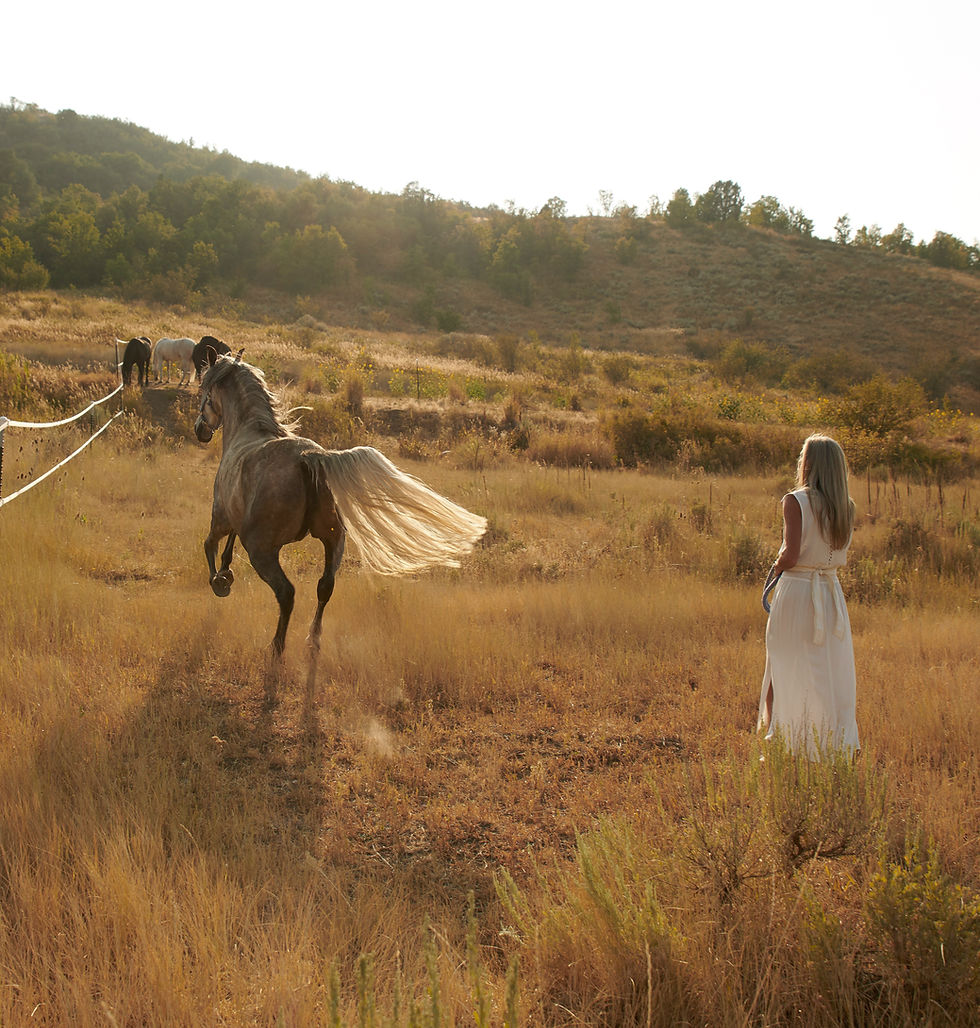
Horses taught me this long before I had language for it. When I stopped filling every encounter with intention, instruction, interpretation, and expectation, I began noticing more: the shift of weight, a change in breathing, the direction of an ear, the softening of an eye, the choice to remain, the choice to leave. The space between us became communicative because I was finally quiet enough to participate in it.
Over time, this way of listening extended beyond horses. The forest became different. Water became different. The movement of birds became different. Even solitude became different. I did not feel that I had entered some supernatural world separate from ordinary life. Ordinary life itself had become more alive.
This is an important distinction. The sacred does not require us to leave the waking world. The waking world itself can become sacred when we are actually present within it. The sun across a horse’s back, the sound of water moving over stone, the smell of earth after rain, a bird calling from a tree, the rhythm of breath within another animal—none of these needs to become a symbol for something else before it is worthy of reverence.
Life is already happening.
And sometimes, within the simplicity of these encounters, something opens. Understanding arrives. The Field of Presence becomes palpable. The sense of separation loosens. A greater intelligence seems very near because, perhaps, it was never far away.
The Zen tradition preserves a story in which the Buddha sat before his students and silently held up a flower. The disciples waited for words, but Mahākāśyapa smiled. The teaching became associated with a transmission beyond words, an understanding communicated directly rather than through explanation.
The image has always carried something beautiful for me. A flower is held up. One person sees. Nothing more is required.
The deepest experiences I have known often have this quality. They do not arrive as arguments, demand belief, or require me to persuade another person that they happened. They simply become part of what I know.
This is also why I have learned to be careful with the word enlightenment. The mind can turn even awakening into another achievement, identity, or spiritual possession. Yet the experiences that have mattered most to me have felt like the opposite of acquisition. Something falls away. The constructed self becomes quiet. The need to explain recedes, and for a moment awareness is simply aware.
Perhaps this is why the ancient teachings so often return us to what is immediate: the breath, the body, the earth, silence, awareness itself.
Living among horses brought these questions out of philosophy and into relationship. The horse could not tell me what consciousness is, nor did I need the horse to become a symbol for an answer. The horse did something more valuable. The horse continually brought me back to the place from which the question could be experienced directly.
What is aware? What remains when the performance quiets? What is present before I name the moment? What is this intelligence that sometimes arrives whole, before thought has had time to construct it?
I cannot claim to have solved the mystery of consciousness, and I no longer believe that solving it is the point. The mystery itself has changed the way I live. It has taught me to listen differently, to hold certainty more lightly, and to respect forms of life and awareness that do not resemble my own. It has made the world feel less like an arrangement of separate objects and more like a living participation in which every being remains itself while belonging to something immeasurably greater.
The more deeply I enter that participation, the more difficult it becomes for me to experience consciousness as something that begins and ends at the borders we have drawn around ourselves.
Perhaps the architecture of consciousness is not an architecture of walls at all.
Perhaps it is an architecture of relationship.


Comments